Demonstration redesign — not the approved participant information sheet
Preterm Lung Health Research
 A clinical trial for babies born very prematurely
Information for parents and carers
Thinking about BALLOON
A clear guide to why your family may be invited, what taking part involves and the questions you may want to ask.
The short version
BALLOON compares Bactek with placebo to find out whether it reduces chest infections.
Babies born before 30 weeks have lungs and immune systems that are still developing. BALLOON provides a fair test of a possible preventive treatment.
Understanding the trial
What you need to know before deciding
Your researcher should explain each point and give you the approved participant information to keep.
Why have we been approached?
Your baby was born before 30 weeks and is receiving care in a neonatal unit taking part in BALLOON. A local researcher confirms eligibility before inviting you. You cannot self-refer and do not need to contact another hospital.
What is BALLOON asking?
The trial is testing whether Bactek, an oral spray given after discharge, reduces chest infections requiring contact with a healthcare professional. We do not yet know whether it works.
What are Bactek and placebo?
Bactek contains inactivated bacterial components that cannot reproduce or cause bacterial infection. Placebo looks and is given in the same way but has no Bactek active ingredients.
How is the group decided?
A secure computer allocates Bactek or placebo by chance. You cannot choose the group. Neither families nor clinical teams normally know the allocation until the trial has finished.
Day-to-day participation
What would our family need to do?
The local team provides training, written instructions and contact details before your baby goes home.
Daily spray
Give the allocated oral spray each day for 12 months after your baby leaves hospital.
Study records
Record the requested information and tell the team about relevant healthcare contacts. Every family is given a WheezeScan to support symptom recording.
Follow-up
Keep in touch with the research team. They will explain the exact schedule before consent.
Chest-infection swabs
You will be given swabs and instructions. If your baby develops a chest infection, you collect nasal and mouth samples and send them directly to Cardiff.
Optional studies
Some families may separately be offered blood sampling or lung-function measurements. Your researcher will explain which elements are optional.
The approved documents are authoritative.
This page is a summary. Dose handling, storage, visit timing and safety reporting must follow the current approved instructions from your team.
A balanced decision
Possible benefits
Your baby may or may not benefit. We do not know whether Bactek prevents chest infections, and your baby may receive placebo. Participation contributes evidence for future families.
Considerations
Possible disadvantages
The spray, recording and follow-up require time. Side effects or unexpected reactions are possible. Optional sampling may cause temporary discomfort. Your researcher will explain known risks and uncertainties.
!
If your baby becomes unwell
Contact your baby’s local clinical service first.
Use the clinical contact provided by your baby’s hospital, or contact their neonatal team, GP or NHS 111. In an emergency, call 999. Do not wait for the BALLOON study email.
Your baby’s information
Confidentiality and your choices
Information is handled according to ethical and legal requirements. Access is limited to authorised people running or checking the study. Information leaving hospital is normally identified by a study number.
You may stop treatment, continue follow-up only, or withdraw from further follow-up. The team will record your choice.
Existing information is normally retained. Regulatory authorities may require limited safety information.
Results report groups, not individual babies. Families may ask to receive the overall findings.
Frequently asked questions
Questions you may want answered
Will taking part help my baby?
We do not know. Bactek may or may not reduce chest infections, and your baby may receive placebo. The evidence may help future families.
What are the possible disadvantages?
The daily spray, symptom recording, WheezeScan use, chest-infection swabs and follow-up take time. Optional blood or lung-function substudies may involve additional procedures. Your team will explain known side effects and uncertainties.
What if we miss a dose?
Do not give extra treatment unless instructed to do so. Follow the supplied guidance and contact the research nurse at your baby’s local hospital if uncertain.
Will usual care change?
No. All usual NHS care continues, including recommended immunisations and infection-prevention treatments, whichever group your baby joins.
Can we stop taking part?
Yes. You can stop treatment or withdraw from further follow-up at any time without giving a reason. Your baby’s care will not be affected.
What happens to information already collected?
It is normally retained so the research remains reliable. Limited safety information may also be required. The approved information sheet explains this fully.
Practical support
Guides for participating families
These supplement—not replace—training from your local team.
Open the full practical guide →Still have questions?
For any trial issue, contact your local hospital research nurse.
They know your baby’s circumstances and can discuss the study treatment, visits and follow-up. For clinical advice, contact your baby’s local clinical service.
For every family after neonatal care
Keeping your premature baby well after going home
A Guide to Chest Infections. A stand-alone health resource about reducing infection risk, RSV protection, caring for coughs and colds, and recognising when to seek medical help. It is separate from the BALLOON Participant Information Sheet.
UK edition | September 2026
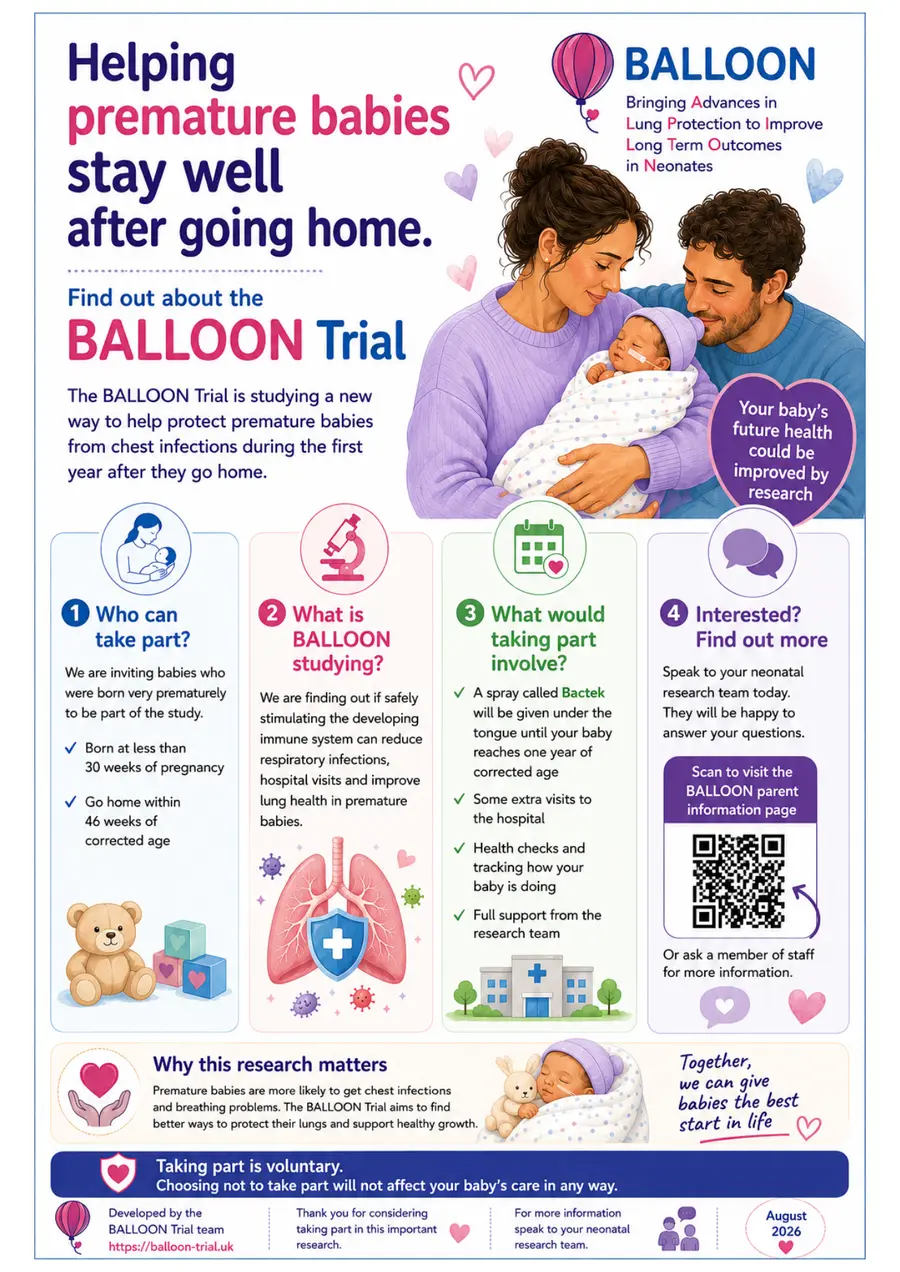
BALLOON Trial poster
Helping premature babies stay well after going home
This A3 notice-board poster gives families a concise introduction to who may be invited, what BALLOON is studying and what taking part involves.
The poster supports an initial conversation with the local neonatal research team. It does not replace the approved Participant Information Sheet or consent discussion.